

『Karman Vortex Air Flow Meter Principle: Tracking Frequency Shedding Behind Blunt Bars for Engine Mass Intake』Related information(clamp on meter|electromagnetic meter|venturi meterrotameter|orifice meter|ultrasonic flow meter|mass flow meter|coriolis mass flow meter|coriolis flow meter|magnetic flow meter|magmeter flow meter|magflow flow meter|mag meter flow meter|electromagnetic flow meter|vortex flow meter|turbine flow meter|thermal mass flow meter|thermal flow meter|rotameter flow meter)
Karman Vortex Air Flow Meter Principle: Tracking Frequency Shedding Behind Blunt Bars for Engine Mass Intake
Quick Answer
A Karman vortex air flow meter measures flow by counting vortex frequency behind a blunt bar. The frequency is linear with flow velocity. For engine mass intake, add pressure and temperature compensation and the meter can output mass flow in kg/h.
How the Karman Vortex Principle Works
Fluid moves past a blunt bar inside the pipe. The bar is also called a bluff body. Vortices form on alternating sides of the bar. The alternating shedding creates a Karman vortex street downstream.
The vortex shedding frequency is proportional to flow velocity. A sensor detects each vortex. Piezoelectric sensors are common in industrial vortex flow meters. The meter converts the frequency to a pulse output or a 4-20 mA HART signal.
The basic equation is f equals St times v divided by d. Here f is frequency in Hz, St is the Strouhal number, v is flow velocity in m/s, and d is the blunt bar width in metres. Most engineers skip the equation because the meter electronics handle the calculation in real time.
Why the Blunt Bar Geometry Matters
The blunt bar produces a stable shedding frequency over a known Reynolds number range. A sharp edge or a thin plate can create unstable vortices. The unstable vortices reduce repeatability at low flow.
Geometry also sets the pressure loss. A wider bar gives a stronger vortex signal but adds more pressure drop. For engine mass intake, pressure drop matters. A 0.5 bar loss on a large turbocharger intake can reduce engine efficiency.
Most industrial vortex meters use a bar width about one fifth of the pipe inner diameter. A DN100 meter typically has a bluff body width around 20 to 25 mm. The ratio keeps the signal clean without high permanent pressure loss.
From Frequency to Engine Mass Intake
A volumetric flow signal alone does not tell you the air mass. Engine mass intake depends on pressure, temperature and volume flow. The vortex meter reports volume flow first. You then add a pressure transmitter and a PT100 temperature sensor. The flow computer or PLC calculates density from the ideal gas law. Mass flow equals volume flow multiplied by density. The output can be kg/h or lb/min.
Some Silver Automation Instruments vortex flow meters accept external pressure and temperature inputs. The electronics then output a mass flow signal directly. A typical loop is 4-20 mA HART for flow, a second 4-20 mA loop for pressure, and a PT100 input for temperature.
We have seen the external compensation setup on customer sites many times. A gas engine packager in Indonesia used a DN80 vortex meter on charge air. The PLC read the frequency input and the 4-20 mA pressure signal. The calculated mass intake matched the engine control system within 2 percent.
Typical Specifications for Engine Air Measurement
Silver Automation Instruments supplies vortex flow meters for air and gas service from DN15 to DN300. For engine mass intake, the common range is DN50 to DN200. Accuracy is plus or minus 1.5 percent of reading for gas. Repeatability is plus or minus 0.25 percent. Turndown can reach 15 to 1 depending on fluid velocity and pipe size.
Standard versions handle process temperatures from -40 °C to 260 °C. Pressure ratings go up to PN40 or ANSI Class 300. For engine intake air, 0 to
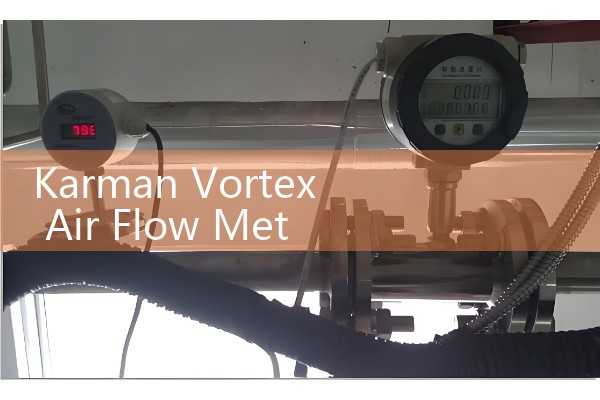
Here is the thing. The installation matters more than the meter noise spec. If upstream straight run is too short, the frequency signal will have jitter. Use 15D to 20D straight run upstream and 5D downstream. D is the pipe internal diameter.
Engine Mass Intake Applications
A Karman vortex air flow meter works well in engine test cells, gas compressor intake lines, marine engine air supply and combustion air to industrial burners. In Vietnam, a diesel engine distributor asked us for a DN100 vortex meter on a test bench. The engine drew 900 kg/h of air at full load. The meter tracked intake swings during throttle steps with a response time under 1 second.
Another customer in Mexico uses a DN150 vortex flow meter on a natural gas engine intake. The meter body is 316L stainless steel. The process gas temperature stays near 40 °C. The output is 4-20 mA HART to the site PLC.
Because vibration can disturb the sensor, avoid mounting the meter directly on engine skids without isolation. Use a remote electronics version if the pipe vibration exceeds 1 g. Flexible connections upstream and downstream also reduce mechanical stress.
Recommended Model and Inquiry Data
For general engine air and gas flow, specify a Silver Automation Instruments inline vortex flow meter with integrated pressure and temperature compensation. The model code includes line size, body material, process connection and output type. A typical DN80 PN16 flanged vortex meter with 4-20 mA HART and integrated PT100 input is enough for a first quotation.
Send us your pressure in bar, temperature in °C, pipe size in DN, and flow range in kg/h or m3/h. Also tell us the gas type, ambient temperature and hazardous area classification if needed. We reply with a model, price and lead time within one business day.
Contact Silver Automation Instruments at Tel +86 25 68650347. For WhatsApp use +86 25 52155837. For WeChat use +86 15365082610.
Frequently Asked Questions
Q: Can a Karman vortex flow meter measure engine air mass directly?
A: The meter measures volume flow first. With pressure and temperature compensation, the electronics can output mass flow in kg/h. Many engine intake applications use external pressure and PT100 inputs to the vortex meter.
Q: What is the minimum pipe size for engine intake air measurement?
A: DN15 is possible but rarely used for engine intake. Most industrial engines need DN50 to DN200. Smaller lines may have low velocity and weak vortex signals.
Q: How much straight run does a vortex flow meter need?
A: Plan for 15D to 20D of straight pipe upstream and 5D downstream. A flow conditioner can reduce the upstream length in tight spaces, but the conditioner adds pressure loss.
Q: Does pressure loss affect engine performance?
A: Yes. The blunt bar creates a permanent pressure loss. For low pressure intake systems, select a meter with a reduced bore or a wider flow range to keep loss low. Provide the maximum allowable pressure drop in your inquiry.
Q: Is a Karman vortex meter suitable for turbocharger surge testing?
A: Yes. The fast frequency output tracks rapid flow changes. Response time below 1 second is common. For surge testing, request a pulse output instead of a heavily damped 4-20 mA signal.
 Hot Blog
 Related AD