

『Kerosene Flow Meter DN15 Laboratory Test Stand Sizing』Related information(clamp on meter|electromagnetic meter|venturi meterrotameter|orifice meter|ultrasonic flow meter|mass flow meter|coriolis mass flow meter|coriolis flow meter|magnetic flow meter|magmeter flow meter|magflow flow meter|mag meter flow meter|electromagnetic flow meter|vortex flow meter|turbine flow meter|thermal mass flow meter|thermal flow meter|rotameter flow meter)
Kerosene Flow Meter DN15 for Laboratory Test Stands: Sizing and Selection Guide
Quick Answer: A DN15 positive displacement or Coriolis flow meter handles kerosene flows from 0.5 L/h up to 100 L/h on a lab test stand. Pick a meter with PTFE seals, 4-20 mA HART output, and secondary containment if your kerosene runs above 40 °C. Send us your pressure (bar), temperature (°C), pipe size (DN), and flow range, and we will return a quote with a data sheet within 24 hours.
Why DN15 Is the First Choice for Kerosene Test Stands
Most lab-scale kerosene test rigs use 6 mm or 8 mm OD tubing. DN15 process connections match these lines without reducers. In practice, a smaller line size keeps the fluid velocity high enough to sweep out air pockets. A DN15 oval gear meter or a DN15 Coriolis meter sits directly in the test loop. It does not need straight run pipe upstream. This saves bench space and cuts fitting costs. We have seen this on customer sites many times. A paint manufacturer in Malaysia runs kerosene at 2.5 bar and 30 °C through a DN15 oval gear meter. Their test stand footprint is less than 400 mm wide.
Meter Type That Works Best with Kerosene
Kerosene has a viscosity around 2 to 5 cP at 20 °C. This is low. Many engineers think a turbine meter is enough. But turbine meters lose accuracy below 2 L/h on DN15 lines. Oval gear meters keep ±0.5 % of reading from 0.5 L/h to 50 L/h on DN15. They do not drift when viscosity changes from cold start to steady state. Coriolis mass flow meters are another solid pick. Our CMF-015 meter measures mass flow directly, shows density, and sends data via Modbus RTU. That helps if your test stand logs mass balance instead of volume.
Material and Seal Selection for Kerosene
Kerosene attacks standard NBR seals over time. The O-rings swell and cause internal leakage. We always specify PTFE or FKM seals on wetted parts for kerosene service. Housing material can be 316L stainless steel or anodized aluminum. Aluminum is lighter and costs less. 316L is better if your cleaning cycle uses hot solvents. A customer in Vietnam ordered a DN15 oval gear meter with PPS gears and PTFE seals last year for a kerosene additive test bench. That meter is still within spec after 18 months.
Sizing Parameters You Must Pin Down
Do not guess the flow range. Measure it or calculate from your dosing pump stroke. Here is the thing. A peristaltic pump feeding a burner nozzle at 0.8 L/h needs a different meter than a gear pump recirculating kerosene at 80 L/h. Give us three numbers: minimum flow, normal flow, and maximum flow. Add your operating pressure. Most lab stands run at 1 to 6 bar. Also tell us the kerosene temperature. Hot kerosene above 60 °C drops viscosity below 1 cP. At that point a Coriolis meter is much safer than an oval gear meter. Because the thin fluid film can slip past the gears.
Signal Output and Data Logging on a Lab Stand
Lab users want a signal that feeds a PLC, a paperless recorder, or a PC. 4-20 mA analog output with HART is the default option. It gives you flow rate and lets you read totalizer and diagnostic registers over HART communicator. Pulse output works well with digital counters. RS485 Modbus is even better for automated test sequences. Silver Automation Instruments builds three signal boards into one DN15 meter body if you need redundancy on a combustion test stand. That way the safety PLC and the data logger get independent signals.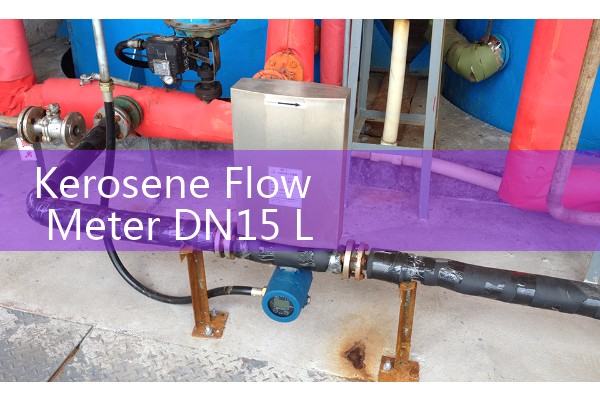 p>
Calibration and Traceability
Every kerosene flow meter we ship to a lab customer leaves with a 5-point calibration certificate. We use a master meter traceable to NIST standards. The test fluid is a kerosene substitute with the same viscosity and density. Calibration points are set at 10 %, 25 %, 50 %, 75 %, and 100 % of your declared flow range. The certificate states the expanded uncertainty, usually 0.2 % for oval gear meters. No extra charge for this on DN15 lab meters.
Quick Sizing Table for DN15 Kerosene Meters
A rough sizing reference helps you start the conversation. The numbers below assume kerosene at 20 °C and 2.5 cP.
0.5 – 10 L/h: oval gear meter with PPS gears and PTFE seals.
10 – 60 L/h: oval gear meter with aluminum housing and PTFE seals.
60 – 100 L/h: oval gear meter or Coriolis meter.
Above 100 L/h: step up to DN20 or consider a Coriolis meter still on DN15 if pressure drop allows.
If your pump pushes kerosene beyond 100 L/h in a DN15 line, check pressure loss. A 100 L/h flow through a small oval gear chamber might drop 0.4 bar. That is normally fine for a 2 bar loop.
How to Avoid Air Bubbles in a Kerosene Flow Meter
Bubbles cause the biggest errors on miniaturized test stands. Kerosene tends to foam when it falls back into an open reservoir. Install the flow meter in the lowest section of the piping. Use a back-pressure valve downstream. A sustained 0.5 to 1 bar back-pressure collapses most bubbles before they reach the meter. If you still see erratic readings at very low flow, switch to a Coriolis meter. It handles two-phase flow better than any PD meter.
Why Engineers in Southeast Asia and the Middle East Choose Silver Automation Instruments
We ship fully built, calibrated DN15 kerosene flow meters within 10 working days to Kuala Lumpur, Jakarta, Dubai, Lagos, and Auckland. Every meter comes with an English data sheet and a quick-start guide. Spare seal kits for kerosene are stocked in our Melbourne forward hub. No long lead times. No hidden courier fees. A water treatment lab in Saudi Arabia ordered three DN15 oval gear meters last month. They received the meters in 9 days via DHL and installed them the same afternoon.
FAQ
Which flow meter type is more accurate for kerosene below 5 L/h?
A positive displacement oval gear meter with PTFE seals delivers ±0.5 % from 0.5 L/h onward. Turbine meters and ultrasonic clamp-on meters cannot match this at micro flows.
Can I use the same DN15 meter for kerosene and diesel?
Yes. Swap the seal material to FKM if you run diesel at higher temperatures. We configure the calibration curve for both fluids and print a dual-fluid certificate.
What output signals do I need for a LabVIEW-based test stand?
Pick RS485 Modbus RTU or 4-20 mA with HART. Our meters talk natively to NI DAQ cards and LabVIEW drivers. We supply the Modbus register map free of charge.
How do I clean a DN15 oval gear meter after kerosene testing?
Flush the meter with isopropyl alcohol at 0.3 bar. Spin the gears slowly. Do not use acetone on PPS plastic gears. PPS withstands alcohol and mild solvents safely.
What is the typical lead time for a kerosene flow meter to the Middle East?
Build and calibration take 7 business days. DHL Express to Dubai or Riyadh takes 2 business days. Reserve 10 business days total from order to doorstep.
 Hot Blog
 Related AD