

『Flow meter conversion』Related information(clamp on meter|electromagnetic meter|venturi meterrotameter|orifice meter|ultrasonic flow meter|mass flow meter|coriolis mass flow meter|coriolis flow meter|magnetic flow meter|magmeter flow meter|magflow flow meter|mag meter flow meter|electromagnetic flow meter|vortex flow meter|turbine flow meter|thermal mass flow meter|thermal flow meter|rotameter flow meter)

Do you know how flow meters are converted into units? The commonly used unit for flow meters is m3/h, which can be divided into instantaneous flow rate (Flow Rate) and total flow rate (Total Flow). Instantaneous flow rate refers to the amount of effective cross-section that passes through a closed pipeline or open channel per unit time. The substances flowing through can be gases, liquids, or solids; Accumulated flow rate refers to the cumulative amount of fluid flowing through the effective cross-section of a closed pipeline or open channel during a certain time interval (one day, one week, one month, one year). The cumulative flow can also be obtained by integrating the instantaneous flow rate with time, so the instantaneous flow meter and the cumulative flow meter can also be converted into each other. The development trend of flow meters is that in industrial fields, instruments that measure the flow rate of a fluid are collectively referred to as flow meters or flow meters. It is one of the most important instruments in industrial measurement. With the development of industry, the accuracy and range requirements for flow measurement are becoming increasingly high. In order to adapt to various applications, various types of flow meters have been introduced and widely used in industries such as oil and gas, petrochemicals, water treatment, food and beverage, pharmaceuticals, energy, metallurgy, pulp and paper, and building materials. 2. How to convert flow meter readings from (1/h) to (kg/s)
1. Firstly, we need to understand the basic unit conversion of flow meter readings.
. Flow meter readings are usually measured in liters per hour (L/h), which we need to convert to kilograms per second (kg/s)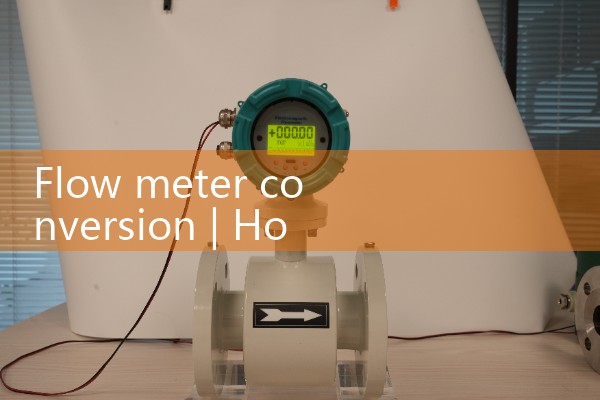
5. In summary, if the density of the medium is p kg/m ³, the calculation formula for converting the flow meter reading from L/h to kg/s is: Jing Shi L/h/3600/1000 * p=kg/s. By following these steps, we can accurately convert the flow meter reading from L/h to kg/s, ensuring that the correct units are retained and the density of the medium is taken into account during the conversion process.
3. How to convert steam flowmeter T and unit Nm ³?
If T represents tons, the conversion relationship between the steam flow meter T and the unit Nm ³ is as follows: 1 ton=1000 kg=1000 kg1 Nm ³=1000 cubic meters. Therefore, the conversion relationship between the steam flow meter T and Nm ³ can be done in the following way: T tons=T * 1000 kgT tons=T * 1000 kg=T * 1000 m ³=T Nm ³, which means that the tonnage of the steam flow meter T and the quantity of Nm ³ are equal.
 Hot Blog
 Related AD