

 Current position > News detail
『Air Flow Meter Sensor Arduino: DIY Pulse Signal Velocity Projects』Related information(clamp on meter|electromagnetic meter|venturi meterrotameter|orifice meter|ultrasonic flow meter|mass flow meter|coriolis mass flow meter|coriolis flow meter|magnetic flow meter|magmeter flow meter|magflow flow meter|mag meter flow meter|electromagnetic flow meter|vortex flow meter|turbine flow meter|thermal mass flow meter|thermal flow meter|rotameter flow meter)
Air Flow Meter Sensor Arduino: DIY Pulse Signal Velocity Projects
Quick Answer: An industrial air flow meter with pulse output can connect directly to an Arduino digital input for flow velocity and total flow projects. For compressed air, combustion air, or biogas, select a vortex flow meter or a thermal mass flow meter with pulse and 4-20 mA outputs. Silver Automation Instruments supplies DN15 to DN300 air flow meters with pulse signal boards for test rigs, burner control, and compressed air monitoring.
Most DIY air flow projects start with a plastic rotor sensor. Those sensors are cheap. They work in a lab. But they fail fast in hot gas, wet air, or pipes above DN50. We have seen this on customer sites many times.
An industrial air flow meter sensor outputs a square wave pulse. Each pulse equals a fixed volume or mass. The Arduino reads the pulse frequency on a digital pin. The code counts pulses over time and converts frequency to velocity or flow rate.
Which Air Flow Meter Sensor Works Best With Arduino
Vortex flow meters work well for air, gas, and steam lines from DN15 to DN200. The pulse output is native. Frequency maps to flow velocity. A typical vortex air flow meter from Silver Instruments has an accuracy of plus or minus 1.0 percent of reading for gas. It can handle media temperature up to 250 degrees C and pressure up to 16 bar. The pulse output is a 24 V square wave. Your Arduino reads it through an optocoupler or a simple resistor divider.
Thermal mass flow meters are the right choice for compressed air and blower air. They measure mass flow directly. No temperature or pressure compensation is needed. Insertion models cover DN50 to DN300. Inline models cover DN15 to DN50. Silver Instruments supplies thermal mass flow meters with 4-20 mA, pulse, and RS485 Modbus outputs. The pulse output can be set for one pulse per 0.1 Nm3 or one pulse per 1 Nm3.
Pulse Output Wiring and Velocity Calculation
An industrial pulse output is not a bare contact closure. It is usually an NPN or PNP transistor output. Power the sensor with 24 V DC. Connect the signal wire to a 10 kOhm pull-up resistor and then to a digital input on the Arduino. Most engineers skip this part and damage the board. Add an optocoupler module. It costs less than 5 USD and protects the Arduino.
For velocity, read the frequency in Hz. Divide frequency by the K-factor of the meter. The K-factor is the number of pulses per unit volume. Example: a DN50 vortex air flow meter has a K-factor of 320 pulses per m3. If the Arduino reads 160 Hz, the flow rate is 160 divided by 320 = 0.5 m3/s. To get velocity, divide the volumetric flow rate by the pipe cross-sectional area.
In practice, use interrupts in the Arduino code. Do not poll the pulse pin. A hardware interrupt catches every pulse even when the loop is busy with display or serial code.
Recommended Sensor Selection for Air Flow Projects
For a compressed air monitoring project in a food and beverage plant, choose an inline thermal mass flow meter. DN25 to DN50 covers most branch lines. For combustion air or biogas lines, choose a vortex flow meter. DN40 to DN100 is common. For wastewater aeration air, use an i
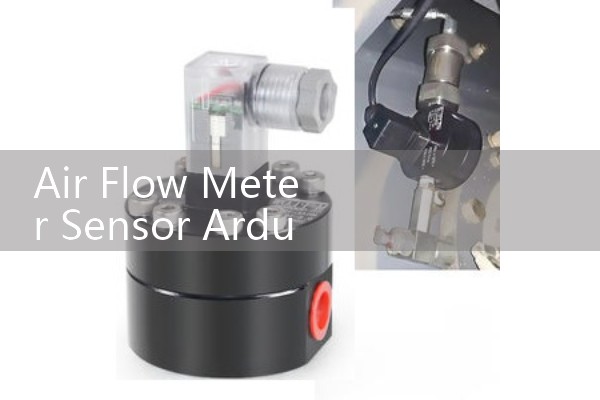
A customer in Vietnam needed compressed air flow data for blow molding machines. The air header was DN80. Silver Instruments supplied an insertion thermal mass flow meter with pulse output. The plant logged pulse counts on an Arduino Due and sent totals to a Modbus display. The project ran for 14 months without sensor drift.
A paint manufacturer in Southeast Asia had a solvent recovery line. The pipe was DN50 and the gas temperature reached 60 degrees C. A hobby sensor would not survive. Silver Instruments supplied a vortex flow meter with pulse output and a local display. The reading was stable from day one.
Why Industrial Users Pair Arduino With Silver Instruments Meters
Arduino is not an industrial PLC. But it is useful for test stands, R and D, energy audits, and local displays. The sensor must still survive the process. A raw hobby sensor cannot handle 8 bar compressed air at 45 degrees C. Silver Instruments builds air flow meters with stainless steel bodies, welded parts, and ATEX options for Zone 1 or Zone 2.
For hazardous areas, request an ATEX or IECEx certified flow meter. The pulse output can connect to a safe-area Arduino through an isolated barrier. We see this setup in chemical pilot plants and gas mixing skids.
How to Order an Air Flow Meter for Arduino Projects
Send us your process data. We need pressure in bar, temperature in degrees C, pipe size DN, gas type, and flow range in kg/h or Nm3/h. We will recommend a meter with the right pulse resolution and output board. Contact Silver Automation Instruments. Tel: +86-25-68650347. Whatsapp: +86-25-52155837. WeChat: +86 15365082610.
FAQ: Air Flow Meter Sensor Arduino and Pulse Signal Projects
Can an Arduino read a pulse output from an industrial air flow meter?
Yes. Use a 24 V DC supply, an optocoupler or voltage divider, and a hardware interrupt pin. The Arduino reads frequency in Hz. Then the code converts frequency to flow rate using the K-factor.
What is the difference between pulse output and 4-20 mA output?
A pulse output gives total flow and flow rate from frequency. A 4-20 mA output gives an analog signal proportional to flow. Many Silver Instruments meters offer both. Use pulse for Arduino counting and 4-20 mA for PLC or display input.
Which flow meter is better for compressed air, vortex or thermal mass?
For small pipes below DN50, inline thermal mass is easy to install and gives mass flow directly. For larger pipes or wet air, a vortex meter is robust. Insertion thermal meters cover DN50 to DN300 with one probe.
What K-factor should I set in Arduino code?
Use the K-factor from the meter calibration certificate. Typical values range from 10 to 5000 pulses per m3 depending on pipe size. Do not copy a generic K-factor from an online project. It will give wrong flow totals.
Can I use a Silver Instruments air flow meter in a hazardous area?
Yes. Request ATEX or IECEx certification. The meter body and electronics can be rated for Zone 1 or Zone 2. The pulse signal can pass through an isolated barrier to a safe-area Arduino.